
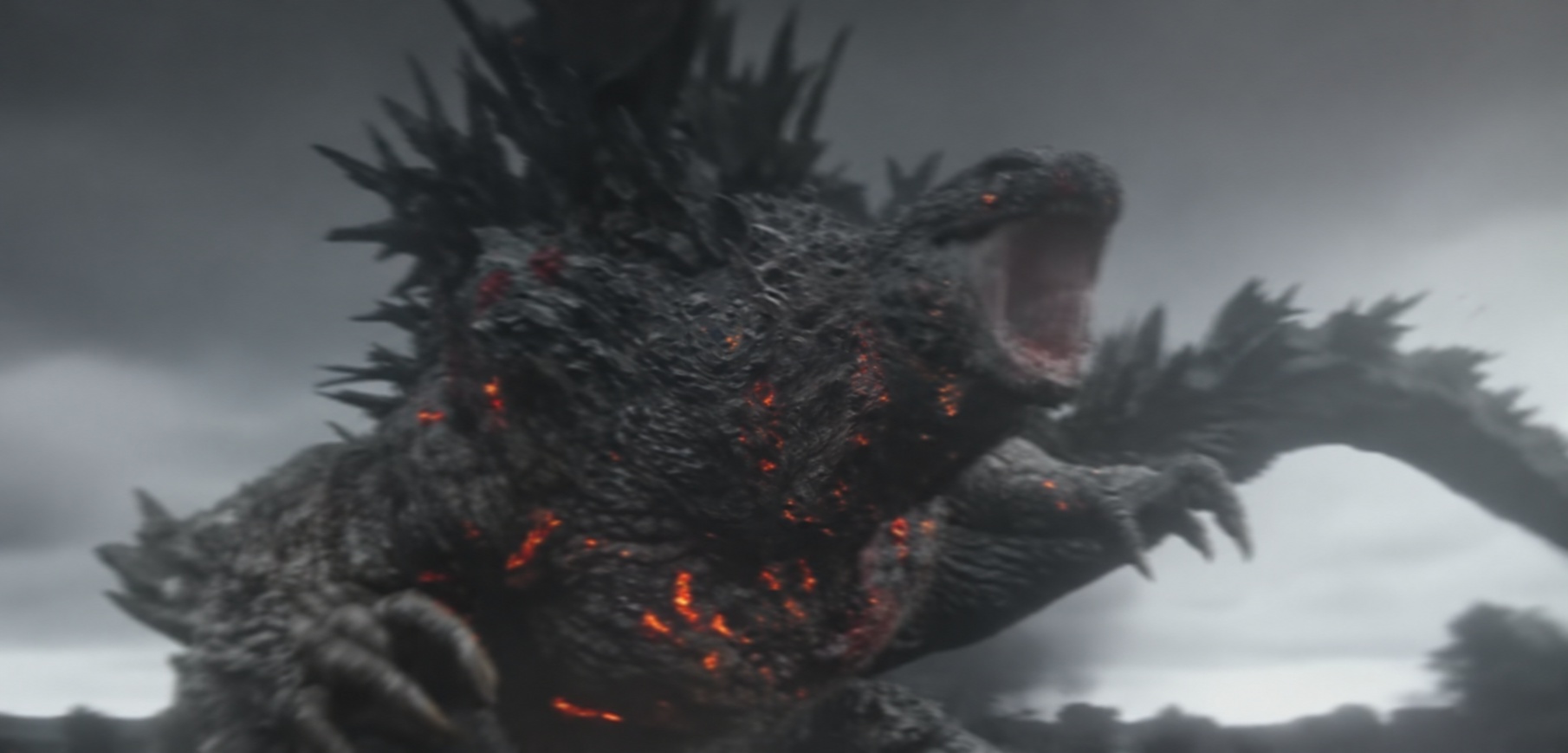
TL;DR: Godzilla Minus Zero is director Takashi Yamazaki’s direct response to Oppenheimer, built from a conversation he had with Christopher Nolan after both films won Oscars in 2024. The result is the most emotionally brutal entry in the 39-film Godzilla franchise, with ground-level war-horror staging that puts most American blockbusters to shame, a King Ghidorah that earned the series its first ever R-rating, and a postwar politics subtext that is not subtext at all. It is also the first Godzilla movie I regretted taking my 10-year-old to.
Table of Contents
The Hiroshima moment I wasn’t ready for
My son has seen almost every Godzilla movie with me in a theater. He is 10. He knows the lore. He has opinions about which Ghidorah design is best.
He had not seen Godzilla Minus One yet. We skipped it when it came out and never circled back. I figured Minus Zero would stand on its own well enough. Mostly it does.
Then the Hiroshima flashback happens.
Professor Murakami, played by Min Tanaka, is the Hiroshima-survivor scientist at the center of the plot. Partway through the film we get his memory of the aftermath. Charred bodies. Children. His own family among them. The camera does not cut away quickly.
I grew up a Cold War kid. My dad explained thermonuclear war to me when I was 6, way too soon, and it cost me a lot of late nights staring at the ceiling trying to figure out how many warheads were pointed at my zip code. I have spent decades years making peace with that. I have also spent 10 years trying to keep my son from inheriting it before he’s ready.
Sitting next to him while that flashback played, I realized I had walked us both into exactly the thing I had been protecting him from. When he asked me later about Hiroshima, I gave him the short version. Americans bombed some Japanese cities in World War II. That’s all he’s getting from me for a while.
That moment is not an accident of the film. Yamazaki built Minus Zero to be that moment. If you understand that going in, you will experience the movie correctly.
The movie Takashi Yamazaki told Christopher Nolan he’d make
Shortly after the 2024 Oscars, where Oppenheimer and Godzilla Minus One both took home statues, Yamazaki met Nolan at the Japanese premiere of Oppenheimer. Yamazaki told him, in person, that he wanted to make a response to Nolan’s film. That is on the public record in a recent TIME interview with Yamazaki.
His original idea was a straight Hiroshima drama. Then he realized Godzilla had been an atomic bomb allegory since 1954 and the response could be a Godzilla movie. Minus Zero is that movie.
No prior film in this 72-year-old franchise has looked at the bomb this directly. Not Honda’s 1954 original. Not Shin Godzilla. The 1954 film used atomic imagery; Minus Zero uses atomic consequences. Yamazaki told TIME he was consciously inspired by the nuclear sequence in Terminator 2, the one where James Cameron shows us what thermonuclear war actually does to a human body.
That is the movie you are buying a ticket to. Know that going in.
What Minus Zero does better than any Godzilla before it
Japanese kaiju filmmaking has always had one real advantage over the American version: it stays on the ground.
American blockbusters film monster attacks from the helicopter. You see skyscrapers fall. You feel the scale. You do not see what it is like to be the person inside the skyscraper. The emotional register is awe, not horror.
Minus Zero stays with the people. When King Ghidorah uses his gravity beam to lift an entire city block into the sky, we are not looking down from a news chopper. We are looking up from the street with a mother holding her small child, watching them rise, watching the moment Ghidorah lets go. The camera stays with them on the fall. That one sequence is reportedly what earned the film its R-rating from the MPA, a first for any Godzilla movie.
The closest recent comparison I can think of is the Korean monster film Hope. Both movies treat a monster attack as a civilian horror story, not a military action set piece. Both understand that the point of view is what makes a monster feel real.
For a counter-example, think about Dakota Fanning in War of the Worlds. Her entire arc was to scream, and the screaming was so sustained and so shrill that it actively turned audiences against the character and arguably against having a daughter. Minus Zero has a small orphan girl named Akiko, played by Sae Nagatani, whose grief makes you want to protect her instead of reaching for the mute button. That is a writing and directing choice. It is also a casting choice that American studios keep getting wrong.
The Japanese emotional register helps too. When adult men shout in grief in a Japanese film, they shout from the diaphragm, from the gut. There is no restraint. Western audiences sometimes read that as melodrama. In the hands of a director who knows what he is doing, it reads as the thing we are too polite to let ourselves do when we lose someone. Minus Zero earns it.
Ghidorah, finally frightening
King Ghidorah has existed since 1964. In most of his appearances he has been camp, or at best spectacle. He is a three-headed golden space dragon. The default mode is fun.
Yamazaki refuses the default. His Ghidorah arrives from space as a gelatinous organism that absorbs local wildlife (a deer, a bird) and becomes a one-headed, winged, lightning-spitting predator that levels the town of Matsumoto in the opening set piece. The transformation into the three-headed gravity-beam-wielding King Ghidorah happens later, after a failed assault, as a direct evolution driven by what humans try to do to kill him. This Ghidorah learns. That is the scary part.
By the time he is in final form, the gravity beam is not a cool effect. It is a weapon of mass displacement. Buildings get lifted and dropped. Trains get thrown. Hundreds die on screen. The wind alone registers as a secondary disaster.
Both monsters in this film are physically heavier than their Legendary MonsterVerse counterparts. Not necessarily taller, but denser. Every footstep carries weight. Every projectile hits harder than it has any business hitting. When Godzilla’s atomic breath finally lands, it reads less like a signature move and more like an execution.
The Americans are the other villain
This is the part of the review where I either lose some of you or get an email forward to the comment section.
Minus Zero casts the American postwar occupation force as an active secondary antagonist. Not just as flawed allies. Not as background. Americans supply the Japanese with planes to fight Ghidorah “on the condition that the Japanese serve as the cannon fodder,” per the plot. They provide a weapon the Japanese head scientist correctly suspects is sabotaged. In the back half of the film, American military priorities shift to seizing Godzilla for weaponization and seizing a mutation-carrying Japanese survivor for research.
Yamazaki says this is deliberate. From the TIME interview: “As time passes, it was important to really take a look at what that relationship between the U.S. and Japan was. I went down the rabbit hole and did a lot of research about U.S. and Japan’s military forces and tension, ultimately leading up to the story we see.”
Previous Godzilla films have poked at America. Shin Godzilla was critical. Godzilla vs King Ghidorah (1991) had an American time-traveling villain who tried to sabotage postwar Japan because it became too economically successful. Minus Zero goes further. The American military is not a character flaw or a plot obstacle. It is the system that the Japanese survivors have to escape at the end of the film.
In a political moment where the US is trying to hold allied coalitions together in the Pacific against a rising China, a major Japanese studio releasing this film with this framing is a statement. It will not land equally well with every American audience. I am telling you to go anyway.
Where it stumbles
Minus Zero is not a flawless film. Minus One was tighter.
Some of the character beats hit melodramatic notes that a 90-minute cut would have earned better than a 135-minute one. A few of the dialogue exchanges between Shikishima and Noriko drift into “we need to say this out loud so the audience catches it” territory. The late-film plot contrivances get a little silly, especially around the device called the Resonance Wave, which is the MacGuffin that lets humans lure Godzilla where they want him.
The 13th Floor film review called Minus Zero a “giant lizard sized step backwards” from Minus One. I don’t agree with that verdict, but the specific complaint about the performances feeling overwrought and the dialogue cliche is fair, and it is the honest thing to note here before you buy a ticket.
The VFX, however, are a clear step forward. Minus One was made for about $15 million and won the visual effects Oscar. Minus Zero had a larger budget and uses every dollar of it. The dogfight sequence against King Ghidorah is some of the most inventive aerial action I have seen in a kaiju film. The final battle in Ginza is a demolition derby of monster anatomy that earns its runtime.
Where I landed
Godzilla Minus Zero is one of the strongest entries the franchise has ever produced. Reviewers who have seen both films are mostly still ranking Minus One ahead of it, giving Yamazaki’s 2023 original the edge on simple elegance. I can see why. This one is carrying more freight: a direct answer to Oppenheimer, a reckoning with the American occupation, and the setup for what is almost certainly a third film in a planned trilogy.
But Minus Zero is bigger. It is angrier. It is more willing to hurt you. If Minus One was Yamazaki showing he could humanize a 72-year-old franchise, Minus Zero is him showing he can use that humanized franchise to say something uncomfortable and true about the century we inherited.
Go see it. In IMAX if you can. Not with a 10-year-old.
[SPOILERS] Godzilla Minus Zero Ending, Explained
Stop reading here if you have not seen the film.
The Resonance Wave is a device built by Professor Murakami, the Hiroshima survivor. It uses Godzilla’s cellular biology to control his movements. Murakami’s secret plan is to use it to send Godzilla to New York City in retaliation for Hiroshima. Kenji Noda, director of the Large-Scale Disaster Response Bureau, eventually talks him out of it.
Noriko, Shikishima’s wife, lost an eye to Godzilla’s atomic blast in the first film. In Minus Zero she wears a bandage over the socket for most of the runtime. During the final battle, she removes the bandage to reveal she has developed Godzilla-like features on that side of her face. Her body absorbed G-cells during her original exposure. Unlike other exposed victims, who regenerated and then died, Noriko survived the mutation. Her G-cells are what the Resonance Wave uses to lure Godzilla to the fight with Ghidorah.
The humans trap Ghidorah in Ginza using liquid nitrogen generators and fuel-based temperature shock. When the fuel lines get cut during the fight, Noda runs out personally to manually trigger the trap. He gets pinned under his vehicle by a Ghidorah gravity beam. Shikishima fires a rocket into the fuel field to detonate the trap, not knowing Noda is still there. Noda dies. Makoto Aoyama, the meteorologist, lies to Shikishima afterward to spare him the guilt.
The Godzilla-Ghidorah fight is brutal and quick. Godzilla severs one of Ghidorah’s heads with his tail, the first time he has used his tail as a katana on screen. Ghidorah bites Godzilla’s arm off. Godzilla regenerates the arm and keeps fighting. Ghidorah still gets the upper hand and gravity-beams Godzilla into the ground. Noriko uses her G-cell connection to wake Godzilla back up. The severed Ghidorah head reattaches itself and has absorbed enough of Godzilla’s biology to grow dorsal spines and attempt a heat-ray. Ghidorah loses control of the heat ray. Godzilla’s own breath finishes him.
After the kill, the American military opens fire on the wounded Godzilla, then receives new orders to stand down and preserve him for weaponization. Godzilla walks slowly into the sea.
Murakami, having talked himself out of revenge, instead burns his Resonance Wave research so the Americans cannot inherit it. He is captured and taken into US custody. Shikishima and Noriko realize Noriko will be hunted for her G-cells. They go to the orphanage to say goodbye to their adopted daughter Akiko and intend to leave her behind to protect her. The goodbye scene wrecks you. They change their minds and take her with them. The three of them escape by sea.
The film sets up a third installment with Godzilla alive and roaming, Murakami in American custody with knowledge the US military wants, and Noriko carrying a mutation that Washington will absolutely come looking for. If Yamazaki makes a Minus One to Minus Zero to Minus Something trilogy, the next one is The Fugitives, postwar Japan edition.
Key Takeaways
- Direct Oppenheimer response. Yamazaki told Christopher Nolan in person he wanted to make this film. The Hiroshima and nuclear-horror imagery is intentional and explicit, a first for the franchise.
- First R-rated Godzilla film. The gravity-beam sequence earned the rating. Deserved.
- Ground-level POV, not helicopter view. The civilian horror framing puts Minus Zero closer to Korean monster cinema (Hope) than to the Legendary MonsterVerse.
- The Americans are the other villain. Not subtext. Yamazaki has said so publicly. Prepare for that going in.
- King Ghidorah has never been this frightening. His gelatinous origin, evolutionary biology, and gravity beam reframe him as a learning adversary, not a camp spectacle.
- Noriko, Shikishima, and little Akiko carry the emotional weight. The family core from Minus One survives into the sequel and gets put through more.
- Second-best Godzilla film ever made. Minus One still edges it on simple elegance. Minus Zero is bigger and angrier.
- A third film is coming. The ending leaves Godzilla alive, Noriko mutated, Murakami captured, and the family on the run.
The Auathor has been watching Godzilla movies in theaters since the Heisei era. Follow more of his movie coverage at Movie Eagle.